

Table hockey is experiencing its most dynamic transformation in decades. New equipment innovations, shifting global competition, and evolving skill requirements are redefining what it takes to excel at every level. While Sweden once dominated international play, countries like Finland, Russia, and the Czech Republic now lead rankings, bringing fresh strategies and intensified competition. Meanwhile, manufacturers have introduced game-changing features like thicker ice sheets, carbon fiber rods, and replaceable components that enhance durability and performance. Whether you’re a seasoned competitor or a casual player, understanding these trends will help you choose the right gear, sharpen your skills, and stay ahead in this rapidly evolving sport.
Table of Contents
- Key takeaways
- Latest equipment innovations reshaping table hockey play
- Shifting global competition landscape and player rankings
- Mastering advanced skills and rod control nuances
- Choosing the right table hockey model for your play style
- Discover your perfect table hockey setup today
- Frequently asked questions
Key Takeaways
| Point | Details |
|---|---|
| Equipment innovations | Thicker ice sheets and carbon fiber rods boost durability and performance, while replaceable parts extend lifespan. |
| ITHF standards | Plan to compete in official tournaments by using equipment that meets ITHF standards from the start. |
| Global leaders shift | Finland, Russia, Czech Republic and Latvia now lead rankings, signaling new strategies and tougher competition beyond traditional Swedish dominance. |
| Budget and play style | Players can select gear based on their play style and budget, balancing mid range performance with personal preferences. |
Latest equipment innovations reshaping table hockey play
The 2026 table hockey equipment landscape showcases remarkable advancements that directly impact how players experience the game. Popular table hockey models include Carrom Super Stick, STIGA NHL Stanley Cup, Irwin Toy, Peter Forsberg Edition, PLAYMOBIL NHL, and Ice Raider with carbon fiber rods. Each model brings distinct features that cater to different skill levels and playing preferences.
The Stiga Playoff 21 features innovations including a 25% thicker ice sheet, new inmould goal counters, goal deflectors, and replaceable parts, making it official for world championships. This thicker playing surface reduces warping over time and provides more consistent puck movement, addressing a common frustration among serious players. The replaceable parts system means you can swap out worn components instead of replacing the entire table, dramatically extending its lifespan and reducing long-term costs.
Carbon fiber rods represent another significant leap forward. Traditional metal rods can bend or corrode after extended use, but carbon fiber maintains its integrity through thousands of games. You’ll notice smoother rotation and more responsive control, especially during rapid offensive sequences. The Ice Raider model incorporates these advanced rods, offering competitive-level performance at a mid-range price point.
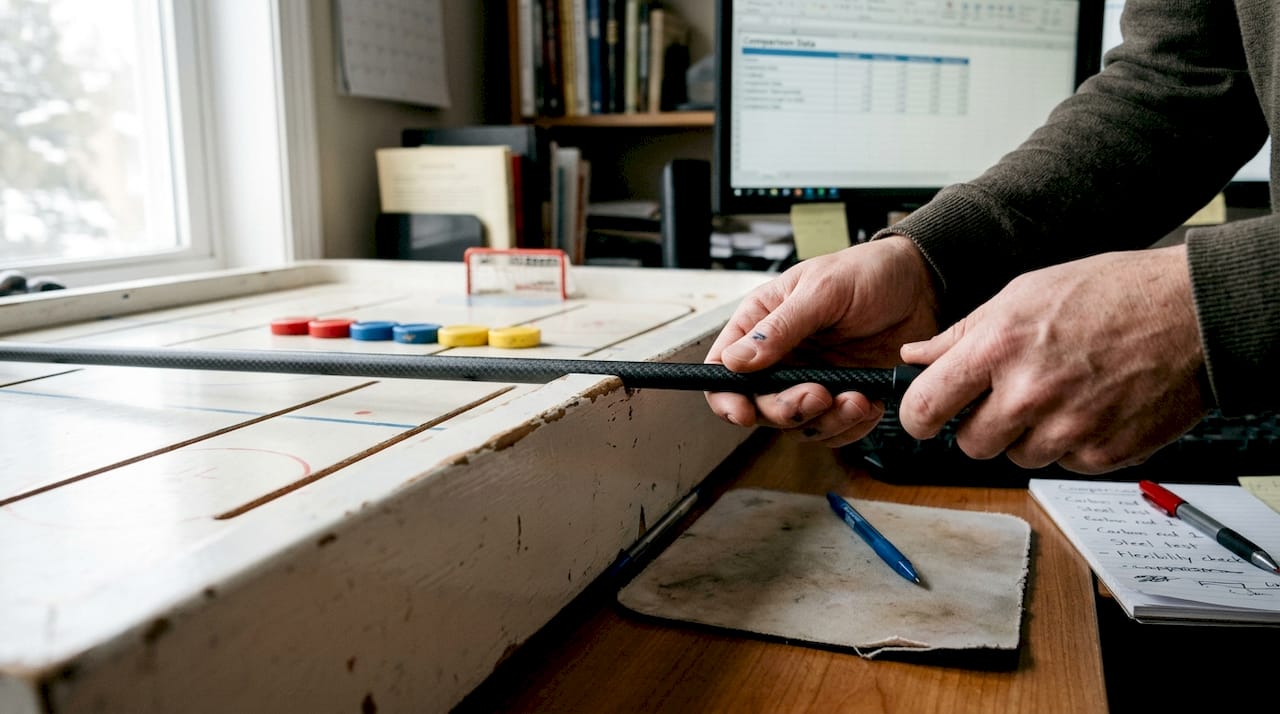
Pro Tip: If you plan to compete in official tournaments, invest in Stiga table hockey details that meet ITHF standards from the start. Practicing on non-regulation equipment can develop habits that don’t translate to tournament play.
| Model | Key features | Ice sheet thickness | Target player |
|---|---|---|---|
| Stiga Playoff 21 | Replaceable parts, goal deflectors, ITHF-approved | 25% thicker than standard | Competitive/tournament |
| Carrom Super Stick | Durable construction, smooth surface | Standard | Intermediate |
| Ice Raider | Carbon fiber rods, responsive control | Enhanced | Advanced casual |
| PLAYMOBIL NHL | Family-friendly design, easy assembly | Standard | Beginner/family |
| Irwin Toy | Budget-friendly, compact size | Standard | Casual/beginner |
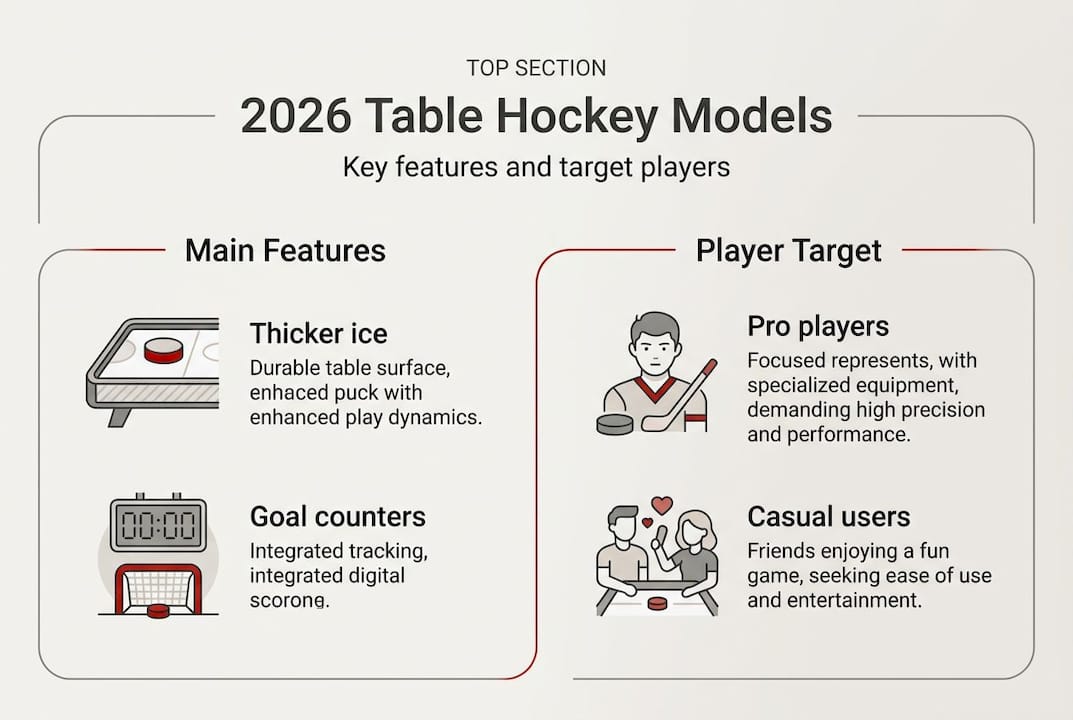
The inmould goal counters on premium models eliminate the need for manual scorekeeping, letting you maintain focus on gameplay rather than tracking points. Goal deflectors add an element of unpredictability that mirrors real hockey, forcing you to adapt your shooting angles and defensive positioning. These seemingly small features combine to create a more immersive and challenging experience that keeps advanced players engaged.
Shifting global competition landscape and player rankings
The international table hockey scene has undergone a dramatic transformation that reshapes competitive opportunities for players worldwide. Global competition shifted from Swedish dominance to players from Finland, Russia, Czech Republic, and Latvia, with structured rankings based on the last two years’ tournaments. This shift didn’t happen overnight but reflects sustained investment in training programs and competitive infrastructure across these nations.
Sweden’s historical dominance stemmed from decades of grassroots development and cultural emphasis on table hockey as a serious sport. Finnish players have now matched that dedication, introducing aggressive offensive strategies that challenge traditional defensive approaches. Russian competitors bring exceptional hand speed and unconventional rod manipulation techniques that force opponents to abandon familiar defensive patterns. Czech players excel at reading opponent tendencies and adapting mid-game, making them particularly dangerous in tournament formats.
The ranking system operates on a rolling two-year window, meaning every tournament performance directly impacts your standing. Points accumulate based on placement in sanctioned events, with world championships and continental tournaments carrying the most weight. This creates constant pressure to maintain consistent performance rather than relying on past achievements. A single poor showing can drop you several positions, while a strong tournament run can vault you into contention.
Key countries rising in the competitive circuit include:
- Finland: Known for aggressive offensive play and rapid transition strategies
- Russia: Features players with exceptional hand speed and creative rod techniques
- Czech Republic: Emphasizes tactical flexibility and mid-game adjustments
- Latvia: Developing strong youth programs that produce technically skilled players
- Canada: Growing competitive presence with focus on power-based gameplay
Pro Tip: Track your tournament results against the official ranking criteria to identify performance gaps. Focus on consistency across multiple events rather than occasional standout performances, since the two-year rolling system rewards sustained excellence.
You can follow table hockey player rankings to see how these shifts play out in real time. The ranking transparency helps emerging players understand exactly what it takes to break into elite tiers. Many national federations now publish detailed statistics showing win rates, average goals per game, and head-to-head records against top opponents.
Mastering advanced skills and rod control nuances
Expert play requires concentration, fast hand-eye coordination, and quick reflexes, while rods enable push/pull/rotate maneuvers and players can go behind the net. These fundamental capabilities separate recreational players from competitive threats. Concentration means maintaining tactical awareness through 20-minute matches where a single lapse can determine the outcome. Hand-eye coordination allows you to track the puck while simultaneously positioning your players for optimal offensive or defensive angles.
Rod maneuvers form the technical foundation of advanced play. Push techniques drive your player forward to intercept passes or pressure the puck carrier. Pull movements create space for shooting lanes or defensive positioning. Rotation generates shooting power and deceptive passing angles that catch opponents off guard. Mastering the timing and combination of these movements takes hundreds of practice hours, but the payoff shows immediately in competitive settings.
The telescopic versus solid rods debate extends to table hockey, where straight rods demand expert nuance in finesse versus power control. Finesse players prioritize precise placement and quick wrist movements, generating unpredictable shot trajectories. Power players emphasize full-arm rotation and maximum velocity, overwhelming opponents with sheer shooting speed. Your natural playing style will determine which approach suits you, though elite players develop competency in both.
Behind-the-net play adds a strategic dimension that novices often overlook. Circling behind the goal creates passing angles that bypass defensive positioning. You can bank shots off the back boards or draw defenders out of position before making a quick centering pass. This maneuver requires spatial awareness and precise rod control, since overrotation or mistimed movements result in turnovers in dangerous areas.
“The difference between good and great players comes down to millisecond reaction times and the ability to execute complex rod sequences without conscious thought. Your hands must respond faster than your opponent can process what’s happening.”
To improve these critical skills, follow this progression:
- Practice isolated rod movements for 15 minutes daily, focusing on smooth push/pull/rotate sequences
- Add puck control drills that combine movement patterns with directional changes
- Work on behind-the-net maneuvers at half speed until the motion becomes automatic
- Gradually increase speed while maintaining precision and control
- Simulate game pressure by setting time limits or creating specific scoring scenarios
Pro Tip: Dedicate at least 20% of your practice time to behind-the-net maneuvers. Most players neglect this area, giving you an immediate tactical advantage when you can execute these plays confidently during matches.
Developing advanced table hockey skills requires deliberate practice that targets specific weaknesses rather than casual play. Film your matches to identify patterns in your decision-making and technical execution. You’ll often discover that losses stem from repeated mistakes in specific situations rather than general skill deficits.
Choosing the right table hockey model for your play style
Selecting equipment that matches your playing approach and budget maximizes enjoyment while supporting skill development. Enthusiasts should prioritize Stiga for competitive play, while casual players can choose budget models like Irwin Toy or PLAYMOBIL. This distinction matters because practicing on equipment that differs significantly from tournament standards can hinder your competitive progress.
Key considerations when evaluating models:
- Price range: Budget options start around $50, while tournament-grade tables exceed $300
- Durability: Look for reinforced corners, quality playing surface materials, and robust rod construction
- Skill level compatibility: Beginners benefit from simpler designs, while advanced players need responsive controls
- Tournament compliance: ITHF approval matters only if you plan to compete in sanctioned events
- Space requirements: Measure your available area before committing to larger competitive models
| Model comparison | Stiga Playoff 21 | Irwin Toy | PLAYMOBIL NHL | Ice Raider |
|---|---|---|---|---|
| Price tier | Premium | Budget | Mid-range | Mid-range |
| ITHF approved | Yes | No | No | No |
| Best for | Tournament players | Casual beginners | Family play | Advancing intermediates |
| Durability rating | Excellent | Good | Good | Very good |
| Special features | Replaceable parts, thick ice sheet | Compact design | Easy assembly | Carbon fiber rods |
Stiga models deliver tournament-level performance with features designed for serious competition. The higher initial investment pays off through longevity and the ability to practice on regulation equipment. You won’t need to adjust your technique when transitioning to tournament play, giving you a significant advantage over competitors who practice on non-standard tables.
Irwin Toy and similar budget models serve casual players perfectly well. You sacrifice some responsiveness and durability, but these tables provide genuine entertainment for family game nights and recreational play. The compact designs fit smaller spaces and store more easily than full-size competitive models.
PLAYMOBIL NHL tables target families with young children, featuring simplified controls and durable construction that withstands rough handling. The easy assembly and breakdown make these models ideal for households where the table won’t remain set up permanently. However, the simplified mechanics don’t translate well to competitive play if your children develop serious interest in the sport.
Ice Raider occupies the middle ground, offering carbon fiber rods and enhanced ice sheets at a price point below premium Stiga models. This represents an excellent choice for intermediate players who want competitive features without the full tournament-grade investment. You can develop advanced techniques on equipment that responds appropriately to skilled play.
Pro Tip: Balance your budget against your commitment level. If you’re uncertain about long-term interest, start with a mid-range model like Ice Raider. You can always upgrade to tournament-grade equipment once you’ve confirmed your dedication to competitive play.
Explore Stiga alternatives 2026 to compare features across manufacturers and identify the best value for your specific needs. Reading detailed comparisons helps you understand which features genuinely impact gameplay versus marketing hype.
Discover your perfect table hockey setup today
Now that you understand the equipment innovations, competitive landscape, and skill requirements shaping table hockey in 2026, you’re ready to take your game to the next level. Table Hockey Global offers curated resources that connect players worldwide, from beginners exploring the sport to professionals refining championship-level techniques.
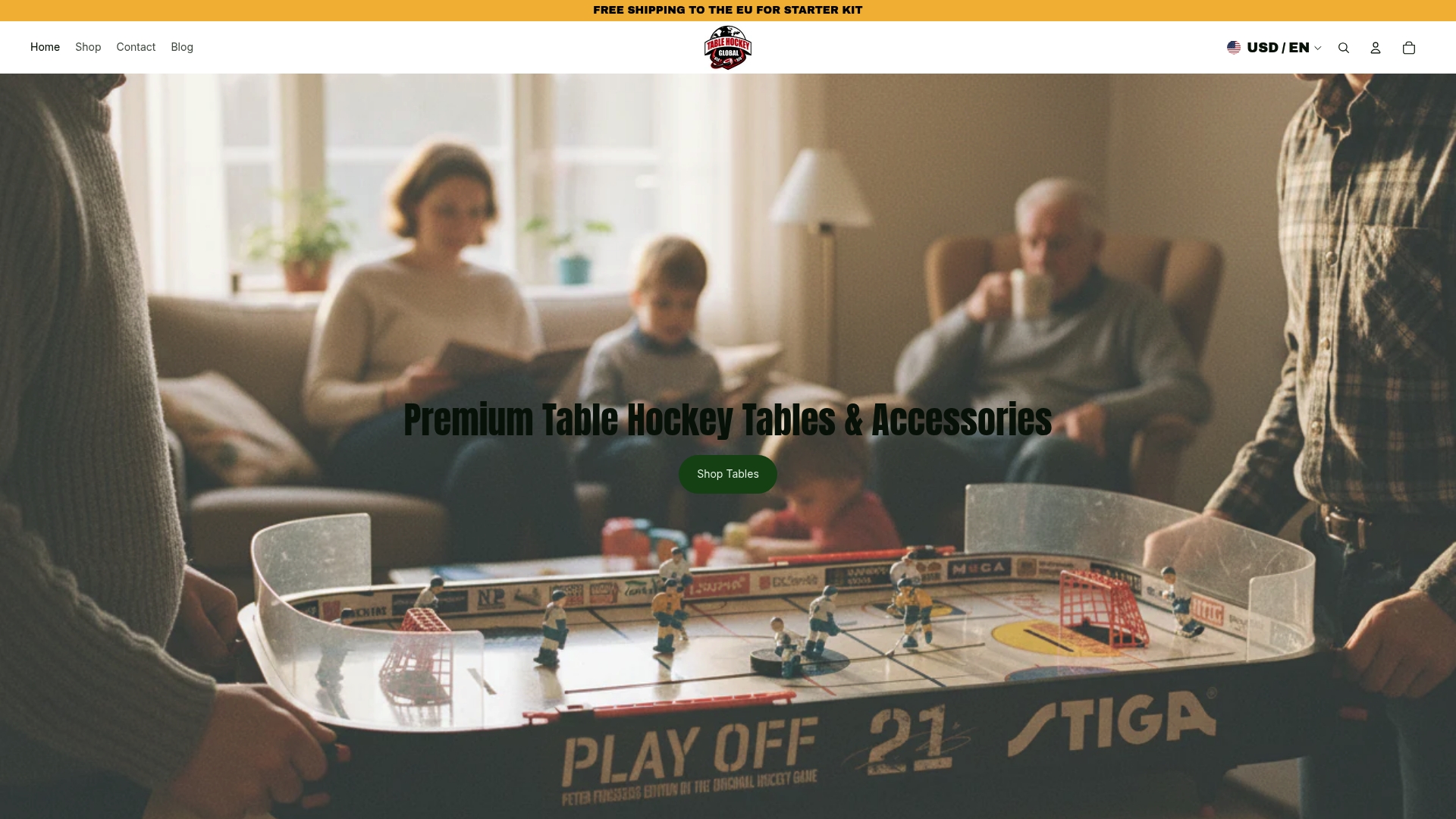
Dive into advanced play strategies 2026 to develop the tactical knowledge that separates good players from great ones. Our table hockey statistics guide helps you track performance metrics and identify areas for improvement. Join a global community where you can share techniques, find local opponents, and stay current on tournament schedules and equipment releases.
Frequently asked questions
What are the new official standards for table hockey equipment?
The Stiga Playoff 21 features a 25% thicker ice sheet and replaceable parts, making it approved for official competition under ITHF standards. The enhanced thickness reduces warping and provides consistent puck movement throughout extended tournament play. Replaceable components mean you can maintain regulation specifications by swapping worn parts rather than replacing the entire table.
How has the global dominance in table hockey changed recently?
Dominance shifted from Sweden to Finland, Russia, Czech Republic, and Latvia, with structured rankings based on the last two years of tournament results. This transformation reflects improved training infrastructure and competitive programs across these nations. The ranking system’s two-year rolling window means current performance matters more than historical achievements, creating opportunities for emerging players to break into elite tiers.
What skills should I focus on to improve my table hockey game in 2026?
Expert play demands fast reflexes, hand-eye coordination, rod maneuvers like push/pull/rotate, and behind-the-net tactics. Concentrate on developing smooth rod control through isolated practice drills before adding game-speed pressure. Behind-the-net play creates scoring opportunities that most recreational players can’t defend against, giving you an immediate competitive advantage once you master the technique.
Which table hockey model is best for casual players?
For casual players, budget models like Irwin Toy or family-friendly PLAYMOBIL are recommended for recreational enjoyment without tournament-level investment. These tables provide genuine entertainment at accessible price points while offering durability suitable for regular family use. If you’re uncertain about long-term commitment, starting with a mid-range option like Ice Raider gives you competitive features at a reasonable cost, allowing you to upgrade later if your interest intensifies.
Recommended
- Table hockey statistics guide: players and fans 2026 – Table Hockey Global
- Master advanced table hockey play: skills and strategies 2026 – Table Hockey Global
- Track table hockey progress and improve your game in 2026 – Table Hockey Global
- Why Table Hockey is a Game-Changer for Child Development: Backed by Re – Table Hockey Global